
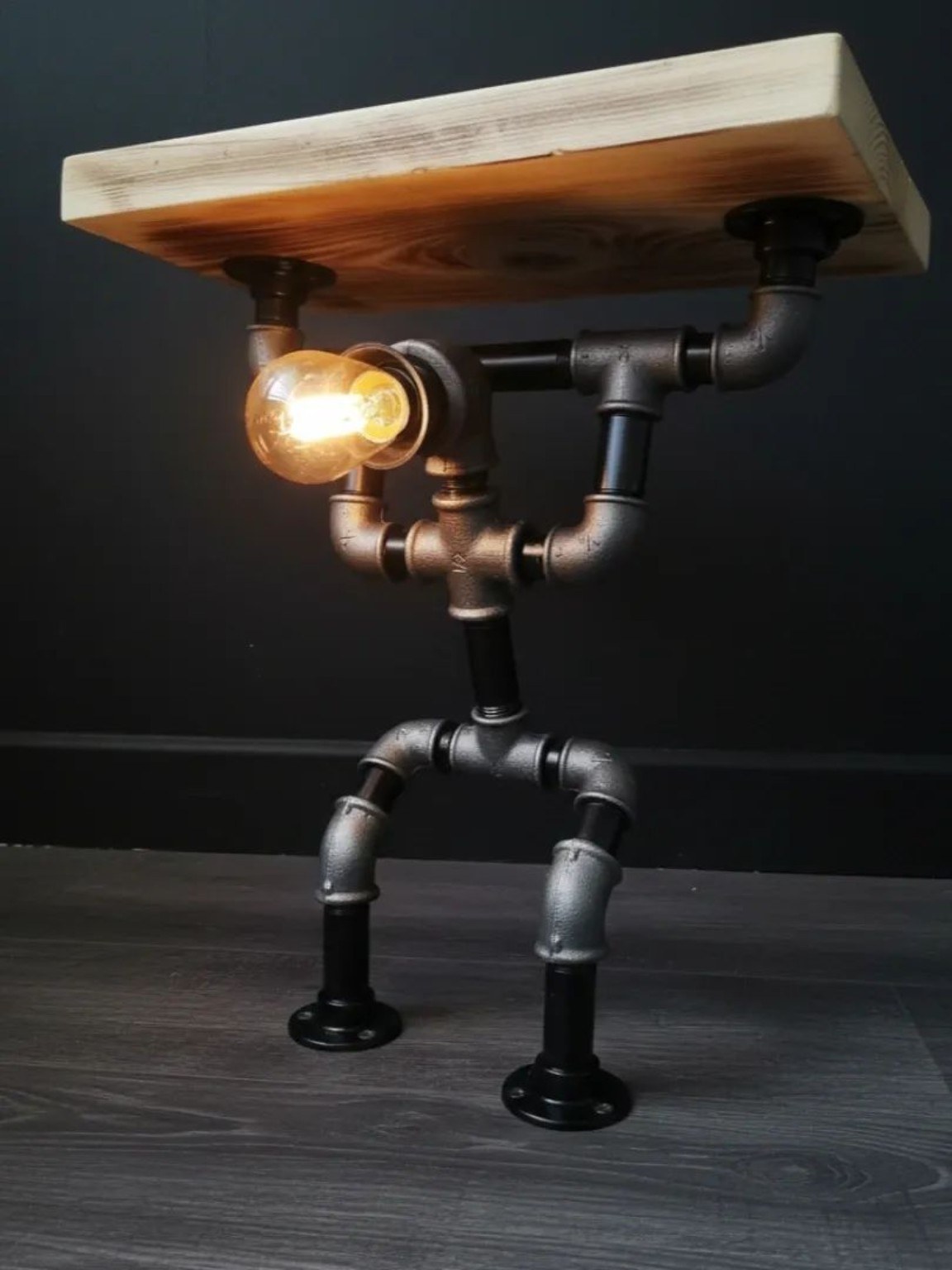
Inside the Forge: How the Pipe Shelf with Lamp Is Built, Pipe by Pipe
A workshop-level account of the Pipe Shelf with Lamp — the black iron stock, the threading, the welds, the patina and the 2200K filament that finishes it.
A portrait in threaded steel
The Pipe Shelf with Lamp begins the way every Pipeart piece begins: as a length of raw black iron plumbing pipe on a steel bench in our Beirut atelier, cut to size and still smelling of mill oil. Industrial pipe shelf with integrated Edison lamp. Custom finish available.
What separates a sculpture from a plumbing assembly is intention. Every elbow angle on this industrial lighting icons piece is chosen for silhouette before it is chosen for structure, and the piece is dry-fitted three or four times — stood up, walked around, photographed against a white wall — before a single joint is tightened for good.
The material: why black iron, not decorative tube
We build in ANSI-threaded black malleable iron — typically 1/2" and 3/4" nominal bore, with 3/8" reserved for fine limbs and detail work. It is heavier than aluminium tube and far heavier than the chrome-plated decorative pipe sold for shelving, and that weight is the point: the Pipe Shelf with Lamp sits where you put it and does not skate across a counter when a cable is tugged.
Malleable iron fittings — elbows, tees, crosses, floor flanges, nipples and unions — are cast, not extruded, so their shoulders carry a soft radius that catches light along the edge. Under a warm filament, that radius reads as a highlight line running the length of every limb, which is exactly why the piece photographs the way it does.
Threading, dry-fit and the geometry problem
Threaded pipe rotates as it tightens, so every joint in the Pipe Shelf with Lamp has a fixed number of turns before it locks — and the limb it carries lands wherever those turns leave it. Getting a steel character to hold a convincing stance therefore means cutting bespoke nipple lengths on the die head, sometimes to the millimetre, so the last half-turn arrives at exactly the angle the pose needs.
Where geometry and thread fight each other, we cheat honestly: a jam nut, a shortened shoulder, or a spot weld behind the joint that locks the rotation without showing on the visible face. The rule in the atelier is simple — no fix may be visible from the front three-quarter view, the angle from which the piece is actually lived with.
Welding, balance and the centre of gravity
Structural welds are laid with MIG on the hidden faces, then dressed back with a flap disc so the bead disappears under the finish. Balance is tested before finishing: the Pipe Shelf with Lamp is placed on a glass sheet and pushed gently at its highest point. If it rocks, the base flange is re-drilled or a counterweight is welded inside the footprint until it does not.
On a industrial lighting icons piece of this scale the centre of gravity sits low and slightly behind the visual centre, which is what allows a dynamic pose to look unstable while being physically immovable. Tension you can see, stability you can trust — that contradiction is the whole craft.
Finish: matte black, patina, brass and custom colourways
The standard finish is a hand-degreased, two-coat matte black — a heat-tolerant enamel that leaves the cast texture of the fittings legible rather than drowning it in gloss. Brass elements (taps, collars, bulb holders) are left raw so they warm and darken with handling, which is a feature and not a defect.
Custom finishes are available on this piece: gunmetal, aged bronze, brushed steel, or a team colourway sprayed and clear-coated. Ask us for a colour and we will send a sprayed offcut of the same pipe stock before we commit the piece to paint, because colour on cast iron never looks like colour on a screen.
Electrics, and what actually lives inside
Wiring runs through the bore of the pipe itself — never taped to the outside — using 2 x 0.75 mm² silicone-jacketed flex rated well above the load, with grommets at every exit so no thread edge can bite the insulation. The lamp holder is a standard E27 ceramic-and-brass unit, so replacement bulbs are available in any hardware shop in Lebanon and worldwide.
We ship the Pipe Shelf with Lamp tuned for 2200K LED filament bulbs in the 4–6 W range: the amber end of the spectrum, where the glow reads as ember rather than office. On Lebanon's 220 V / 50 Hz supply, that is roughly the light of two good candles per bulb, dimmable if you pair it with a trailing-edge dimmer. It runs equally happily on 110 V with the appropriate bulb.
Beirut, and why this work exists here
Pipeart works out of Beirut, a city that has spent decades rebuilding itself out of whatever was to hand. Plumbing pipe is the most ordinary material in the country and the most available; turning it into a light that people put in the best corner of their home is a small argument about what ordinary materials are worth.
Every piece leaves the bench signed and photographed. Nothing is cast, moulded or mass-produced, which is why two units of the Pipe Shelf with Lamp are never dimensionally identical — the thread decides, and the thread is never twice the same.
Owning this piece
The Pipe Shelf with Lamp is listed at $95 and is made to order in the atelier, with typical lead times of a few days for in-stock configurations and one to two weeks for custom finishes or dimensional changes. Lighting icons are sized for a surface: check you have the depth for the base before you clear the shelf.
Cash on delivery is available across Lebanon; worldwide shipping is crated and insured. Talk to us on WhatsApp before you order if you want a specific height, a longer cord, a wall plate instead of a base, or a colourway — none of those are extras we invented, they are simply how a hand-built object should be bought.
Written in the Pipeart atelier, Beirut.
Dans l'atelier : la fabrication du Pipe Shelf with Lamp, tuyau par tuyau
Récit d'atelier autour du Pipe Shelf with Lamp — le fer noir brut, le filetage, les soudures, la patine et le filament 2200K qui achève la pièce.
Un portrait en acier fileté
Le Pipe Shelf with Lamp commence comme toute pièce Pipeart : une longueur de tuyau de plomberie en fer noir brut posée sur l'établi de notre atelier beyrouthin, coupée à la mesure et sentant encore l'huile d'usinage. Industrial pipe shelf with integrated Edison lamp. Custom finish available.
Ce qui sépare une sculpture d'un assemblage de plomberie, c'est l'intention. Chaque angle de coude de cette pièce icônes de l'éclairage industriel est choisi pour la silhouette avant de l'être pour la structure, et l'ensemble est présenté à blanc trois ou quatre fois — dressé, contourné, photographié contre un mur blanc — avant qu'un seul raccord ne soit serré définitivement.
La matière : pourquoi le fer noir plutôt que le tube décoratif
Nous travaillons le fer malléable noir fileté à la norme ANSI — le plus souvent en 1/2" et 3/4", le 3/8" étant réservé aux membres fins et aux détails. C'est plus lourd que le tube d'aluminium et bien plus lourd que le tube chromé vendu pour l'étagère : ce poids est l'argument même, car le Pipe Shelf with Lamp reste là où vous le posez et ne glisse pas sur un comptoir lorsqu'on tire sur le câble.
Les raccords en fer malléable — coudes, tés, croix, brides, mamelons et unions — sont moulés et non extrudés : leurs épaulements portent un rayon doux qui accroche la lumière sur l'arête. Sous un filament chaud, ce rayon devient une ligne de brillance qui court le long de chaque membre, et c'est exactement pour cela que la pièce se photographie ainsi.
Filetage, montage à blanc et problème de géométrie
Un tuyau fileté tourne en se serrant : chaque assemblage du Pipe Shelf with Lamp dispose d'un nombre fixe de tours avant blocage, et le membre qu'il porte s'arrête là où ces tours le laissent. Faire tenir une posture crédible à un personnage d'acier suppose donc de couper des mamelons sur mesure à la filière, parfois au millimètre près, pour que le dernier demi-tour arrive exactement à l'angle voulu.
Quand la géométrie et le filetage s'opposent, nous trichons honnêtement : contre-écrou, épaulement raccourci, ou point de soudure derrière l'assemblage qui bloque la rotation sans se voir en façade. La règle de l'atelier est simple : aucune correction ne doit être visible depuis le trois-quarts avant, l'angle sous lequel on vit réellement avec la pièce.
Soudure, équilibre et centre de gravité
Les soudures structurelles sont réalisées au MIG sur les faces cachées, puis reprises au disque à lamelles pour que le cordon disparaisse sous la finition. L'équilibre est testé avant peinture : le Pipe Shelf with Lamp est posé sur une plaque de verre et poussé doucement à son point le plus haut. S'il bascule, la bride est repercée ou un contrepoids est soudé à l'intérieur de l'emprise.
Sur une pièce icônes de l'éclairage industriel de cette échelle, le centre de gravité se situe bas et légèrement en arrière du centre visuel : c'est ce qui permet à une posture dynamique de paraître instable tout en étant physiquement inamovible. Une tension que l'on voit, une stabilité à laquelle on se fie — cette contradiction est tout le métier.
Finition : noir mat, patine, laiton et teintes personnalisées
La finition standard est un noir mat en deux couches sur support dégraissé à la main — un émail résistant à la chaleur qui laisse lisible la texture de fonte des raccords au lieu de la noyer sous le brillant. Les éléments en laiton (robinets, colliers, douilles) restent bruts : ils se réchauffent et foncent à l'usage, ce qui est une qualité et non un défaut.
Des finitions personnalisées sont possibles : gunmetal, bronze vieilli, acier brossé ou une livrée aux couleurs d'un club, vernie. Demandez une teinte et nous vous enverrons une chute du même tuyau peinte avant d'engager la pièce, car une couleur sur fonte ne ressemble jamais à une couleur sur écran.
L'électricité, et ce qui vit réellement à l'intérieur
Le câblage passe dans l'âme du tuyau — jamais collé à l'extérieur — en souple silicone 2 x 0,75 mm² largement surdimensionné, avec un passe-fil à chaque sortie pour qu'aucune arête filetée ne morde l'isolant. La douille est une E27 céramique et laiton standard : les ampoules de remplacement se trouvent dans n'importe quelle quincaillerie, au Liban comme ailleurs.
Nous livrons le Pipe Shelf with Lamp calibré pour des ampoules LED à filament de 2200K en 4 à 6 W : l'extrémité ambrée du spectre, là où la lueur évoque la braise et non le bureau. Sur le 220 V / 50 Hz libanais, cela équivaut à peu près à deux bonnes bougies par ampoule, variable avec un gradateur à coupure de phase descendante. La pièce fonctionne aussi bien en 110 V avec l'ampoule adéquate.
Beyrouth, et pourquoi ce travail naît ici
Pipeart travaille depuis Beyrouth, une ville qui se reconstruit depuis des décennies avec ce qu'elle a sous la main. Le tuyau de plomberie est le matériau le plus ordinaire et le plus disponible du pays ; en faire une lumière que l'on installe dans le plus bel angle de son salon est une petite démonstration de ce que valent les matériaux ordinaires.
Chaque pièce quitte l'établi signée et photographiée. Rien n'est moulé ni produit en série : deux exemplaires du Pipe Shelf with Lamp ne sont jamais dimensionnellement identiques, car c'est le filetage qui décide, et il ne décide jamais deux fois pareil.
Acquérir cette pièce
Le Pipe Shelf with Lamp est proposé à 95 $ et fabriqué à la commande, avec des délais de quelques jours pour les configurations disponibles et d'une à deux semaines pour une finition ou une dimension particulière. Les icônes d'éclairage sont dimensionnées pour un plan : vérifiez la profondeur disponible pour le socle.
Paiement à la livraison partout au Liban ; expédition mondiale en caisse et assurée. Écrivez-nous sur WhatsApp avant de commander si vous souhaitez une hauteur précise, un cordon plus long, une platine murale au lieu d'un socle ou une teinte : ce ne sont pas des options inventées, c'est simplement ainsi que s'achète un objet fait main.
Rédigé dans l'atelier Pipeart, Beyrouth.
داخل الورشة: كيف يُصنع «Pipe Shelf with Lamp» أنبوباً بعد أنبوب
حكاية من قلب المشغل عن «Pipe Shelf with Lamp» — الحديد الأسود الخام، القلاووظ، اللحام، الباتينا، وفتيلة 2200K التي تُتوّج القطعة.
بورتريه من فولاذ مقلوَظ
يبدأ «Pipe Shelf with Lamp» كما تبدأ كل قطعة من Pipeart: قضيب أنابيب سباكة من الحديد الأسود الخام على طاولة العمل في مشغلنا ببيروت، مقصوصاً على المقاس ولا تزال رائحة زيت التصنيع عالقة به. Industrial pipe shelf with integrated Edison lamp. Custom finish available. — وهي قطعة مبنية يدوياً بالكامل: ملحومة ومقلوَظة ومطلية وموصولة كهربائياً واحدة تلو الأخرى.
ما يفصل المنحوتة عن تركيبة سباكة هو النيّة. كل زاوية كوع في هذه القطعة من فئة أيقونات الإضاءة الصناعية تُختار للظل والسيلويت قبل أن تُختار للبنية، وتُركَّب القطعة على الجاف ثلاث أو أربع مرات — تُنصَب، ويُدار حولها، وتُصوَّر أمام جدار أبيض — قبل أن يُشدّ أي وصل نهائياً.
المادة: لماذا الحديد الأسود لا الأنبوب الزخرفي
نبني بالحديد الطيّع الأسود المقلوَظ بمعيار ANSI — غالباً بقطر ½ و¾ إنش، ويُحفَظ مقاس ⅜ للأطراف الدقيقة والتفاصيل. إنه أثقل من أنبوب الألمنيوم وأثقل بكثير من الأنبوب المكروم المخصّص للرفوف، وهذا الثقل هو المقصود: «Pipe Shelf with Lamp» يبقى حيث تضعه ولا ينزلق على الكاونتر إذا شُدّ سلكه.
وصلات الحديد الطيّع — أكواع، تيهات، صلبان، فلنجات، ونيبلات — مصبوبة لا مبثوقة، فتحمل أكتافها انحناءً ناعماً يلتقط الضوء على الحافة. تحت فتيلة دافئة يقرأ هذا الانحناء كخط لمعان يجري على طول كل طرف، ولهذا تظهر القطعة في الصور بهذا الشكل.
القلاووظ والتركيب الجاف ومسألة الهندسة
الأنبوب المقلوَظ يدور وهو يُشدّ: لكل وصلة في «Pipe Shelf with Lamp» عدد دورات ثابت قبل أن تقفل، والطرف الذي تحمله يستقرّ حيث تتركه تلك الدورات. لذلك فإن جعل شخصية من فولاذ يحمل وقفة مقنعة يعني قصّ نيبلات بمقاسات خاصة على آلة القلاووظ، أحياناً بدقة الملّيمتر، ليصل نصف الدورة الأخير إلى الزاوية التي تتطلبها الوقفة تماماً.
وحين تتصارع الهندسة مع القلاووظ نحتال بأمانة: صامولة قفل، أو كتف مقصوص، أو نقطة لحام خلف الوصلة تمنع الدوران دون أن تظهر في الواجهة. القاعدة في المشغل بسيطة: لا يجوز أن يُرى أي إصلاح من زاوية ثلاثة أرباع الأمامية، وهي الزاوية التي يعيش الناس معها فعلياً.
اللحام والتوازن ومركز الثقل
تُنفَّذ اللحامات الإنشائية بجهاز MIG على الأوجه المخفية ثم تُسوّى بقرص شفرات حتى يختفي الخط تحت الطلاء. ويُختبر التوازن قبل التشطيب: يوضع «Pipe Shelf with Lamp» على لوح زجاج ويُدفع برفق من أعلى نقطة فيه. فإذا ترنّح، تُعاد ثقوب الفلنجة أو يُلحَم ثقل موازن داخل مساحة القاعدة.
في قطعة من فئة أيقونات الإضاءة الصناعية بهذا الحجم، يقع مركز الثقل منخفضاً وخلف المركز البصري قليلاً، وهذا ما يسمح لوقفة ديناميكية أن تبدو غير مستقرة بينما هي راسخة فيزيائياً. توتّر تراه، وثبات تثق به — هذا التناقض هو الحرفة كلها.
التشطيب: أسود مطفأ، باتينا، نحاس وألوان مخصّصة
التشطيب القياسي أسود مطفأ بطبقتين على سطح مُزال دهنه يدوياً — إيناميل يتحمّل الحرارة ويُبقي ملمس الصبّ في الوصلات مقروءاً بدل إغراقه باللمعان. أما عناصر النحاس (الحنفيات، الأطواق، الأباجورات) فتُترك خاماً لتدفأ وتغمق مع الاستعمال، وهذه ميزة لا عيب.
التشطيبات المخصّصة متاحة: رمادي بارودي، برونز معتّق، فولاذ مصقول، أو ألوان فريق رياضي مع طبقة حماية شفافة. اطلب لوناً ونرسل لك قصاصة من الأنبوب نفسه مطلية قبل أن نطلي القطعة، لأن اللون على الحديد المصبوب لا يشبه أبداً اللون على الشاشة.
الكهرباء وما يعيش فعلاً في الداخل
يمرّ السلك داخل تجويف الأنبوب نفسه — لا يُلصق أبداً على الخارج — بكابل سيليكون مرن 2×0.75 مم² بقدرة تفوق الحمل بكثير، مع جلبة عند كل مخرج كي لا تعضّ حافة القلاووظ العازل. الليّة قياسية E27 من السيراميك والنحاس، فتتوفر لمبات البديل في أي محل عدّة في لبنان والعالم.
نسلّم «Pipe Shelf with Lamp» مضبوطاً على لمبات LED فتيلية بحرارة 2200K وقدرة 4 إلى 6 واط: الطرف الكهرماني من الطيف حيث يقرأ الوهج كجمرة لا كإنارة مكتب. على شبكة 220 فولت / 50 هرتز في لبنان يعادل ذلك تقريباً ضوء شمعتين جيدتين لكل لمبة، وقابل للتعتيم مع دِمر مناسب. ويعمل بالكفاءة نفسها على 110 فولت باللمبة الملائمة.
بيروت، ولماذا يولد هذا العمل هنا
تعمل Pipeart من بيروت، مدينة أمضت عقوداً تعيد بناء نفسها بما تجده تحت يدها. أنبوب السباكة هو أكثر المواد اعتيادية وتوفراً في البلد؛ وتحويله إلى ضوء يوضع في أجمل زاوية من البيت هو حجّة صغيرة على قيمة المواد العادية.
كل قطعة تغادر الطاولة موقّعة ومصوَّرة. لا شيء يُصبّ أو يُنتج بالجملة، ولهذا لا تتطابق نسختان من «Pipe Shelf with Lamp» بالمقاس تماماً — القلاووظ هو من يقرّر، وهو لا يقرّر مرتين بالطريقة نفسها.
اقتناء القطعة
«Pipe Shelf with Lamp» معروض بسعر 95 دولار ويُصنع عند الطلب في المشغل، بمهلة أيام قليلة للتكوينات المتوفرة وأسبوع إلى أسبوعين للتشطيبات أو المقاسات الخاصة. أيقونات الإضاءة مقاسة لسطح محدد: تأكد من توفر العمق الكافي للقاعدة قبل إفراغ الرفّ.
الدفع عند التسليم متاح في كل لبنان، والشحن العالمي داخل صناديق خشبية ومؤمَّن. راسلنا على واتساب قبل الطلب إذا أردت ارتفاعاً محدداً أو سلكاً أطول أو قاعدة جدارية بدل القاعدة الأرضية أو لوناً خاصاً: ليست هذه إضافات اخترعناها، بل هي ببساطة الطريقة التي يُشترى بها عمل يدوي.
كُتب في مشغل Pipeart، بيروت.